A Way to Please the Fearless One
Published on December 2, 2025
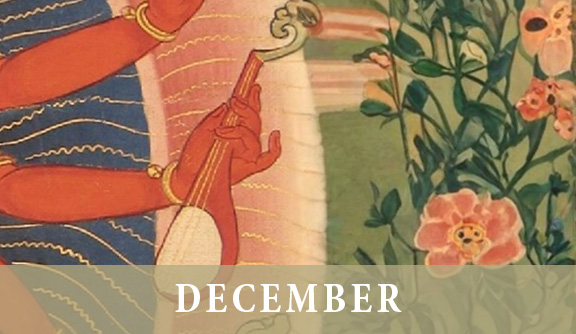
Our December Text of the Month is A Way to Please the Fearless One, a sādhana of Red Sarasvatī in union with Mañjuśrī.
Sarasvatī, known in Tibetan as Yangchenma—“the Melodious One”—embodies qualities of intelligence, learning, and expressive grace. Revered for her connection to speech, music, and poetry, she has long inspired practitioners engaged in study, translation, and creative expression. This rare sādhana offers a path to awakening supreme intelligence and expressive power, transforming ordinary consciousness into the vajra speech of realization. It also reflects Jamyang Khyentse Wangpo’s broad vision and dedication in preserving and transmitting female-centered practices that express the full range of Vajrayāna wisdom.
Explore this text and related materials in our reading room.
Teaching with Chagdud Khadro
As the special guest teacher of this month, we were delighted to welcome Chagdud Khadro, who offered a teaching on this beautiful text. Khadro la spoke about Sarasvatī’s blessings related to wisdom, eloquence, and clarity of intelligence, placing the practice within the framework of the Buddha families, with particular focus on the Lotus family and its connection to speech and emotion.
Please note: This talk is meant to serve as a source of inspiration and connection. The actual practice of the sādhana requires empowerment and personal instruction from an authentic teacher.
Chagdud Khadro met His Eminence Chagdud Tulku Rinpoche in 1978 and married him in 1979. She was his student for twenty-three years. Rinpoche ordained her as a lama in 1997 and appointed her as the future spiritual director of Chagdud Gonpa Brasil.
Since Rinpoche’s Parinirvana in 2002, Khadro has focused on continuing the high-quality Vajrayana training he established and passed to her. She has been committed to safeguarding Rinpoche’s legacy, including overseeing the construction of a Zangdog Palri: Guru Rinpoche’s Pure Land. As a former director and editor of Padma Publishing in the United States, Khadro has edited numerous translations of Tibetan texts and continues her work on translations and publications in Portuguese and Spanish.