
Music to Delight the Ḍākinī: A Praise to Deathless Mandāravā
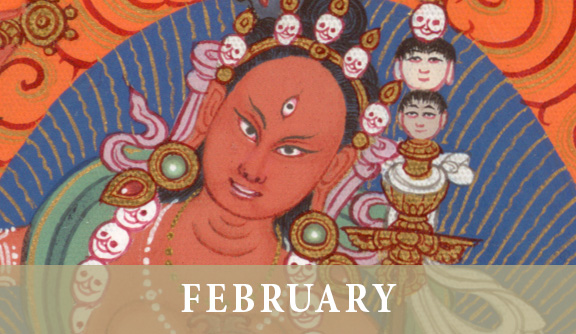
Our February text of the month is Music to Delight the Ḍākinī: A Praise to Deathless Mandāravā, a spontaneous praise by Jamyang Khyentse Wangpo.
In this spontaneously composed evocative poem, Jamyang Khyentse Wangpo reflects on the enlightened qualities and abilities of this wisdom ḍākinī, who became one of Padmasambhava’s principal consorts and played a vital role in the guru’s accomplishment of immortality. Khyentse Wangpo’s evocative supplication is particularly special as it depicts her in a semi-wrathful form, an expression of her enlightened power to liberate beings, bestow siddhis, and remove obstacles to life.
The first seven stanzas, each concluding with an offering of praise, describe Mandāravā’s attributes and qualities, her manifestation of the major and minor marks, and her abilities to liberate beings, bestow siddhis, cut through dualistic thoughts, and clear obstacles to one’s life. This composition is particularly special as it depicts her in a semi-wrathful form, an expression of her enlightened power to liberate beings, bestow siddhis, and remove obstacles to life.
Explore this text and related materials in our reading room.
Teaching with Sangye Khandro
For the teaching on this text, we had the privilege of welcoming Sangye Khandro.
In this session, Khandro la discusses the spiritual significance of Princess Mandāravā, providing a detailed analysis of the prayer’s metaphorical language and symbolism. She explains that outwardly, Mandāravā appears as a nirmanakāya Buddha—an intentional emanation who manifests in this world to guide beings. Inwardly, she is the sambhogakāya, perceptible to advanced practitioners. Secretly, she embodies the threefold wisdom essence of Buddha nature: emptiness, luminosity, and unceasing compassion.
At Maratika Cave in Nepal, Mandāravā and Guru Rinpoche achieved the state of an immortal vidyādhara, transcending ordinary birth and death. Her activity has continued through many manifestations over time, inspiring practitioners on their path to liberation.
Sangye Khandro has been a practising Buddhist since 1972 and a Dharma translator since 1976. A close student of Kyabjé Dudjom Rinpoche, Sangyum Kusho, Venerable Gyatrul Rinpoche, and Kyabjé Thinley Norbu Rinpoche, she is a co-founder of the translation group Light of Berotsana and has dedicated her life to translating and transmitting essential Vajrayāna texts and teachings.