
Tech & A.I.
At KVP, we embrace technological innovation in service of the authentic transmission of the Vajrayāna tradition.

Introduction
We are witnessing a monumental shift in how knowledge is processed, disseminated, and preserved. The accelerating use of artificial intelligence and machine translation in the transmission of Buddhism has profound implications that go far beyond the technical.

Watch Buddhadharma magazine’s interview with Dolma Gunther, Casey Forgues, and Zack Beer about AI’s impact on Buddhism and its significance for translators and practitioners.
How do we embrace technological change while avoiding the pitfalls of the commodification of the Dharma, the dilution of lineage transmission, the muddying of subtle philosophical distinctions, and the resulting impact of spiritual bypass? The approach we take to integrating AI into our work can substantially shape how this precious wisdom tradition is made available to future practitioners, who rely on the texts we produce as a path to awakening.
KVP has been proactive in embracing translation tool technology and artificial intelligence to the extent that they support our mission. Our position is neither uncritical enthusiasm nor reflexive resistance. AI tools, used wisely, can help us do this work better: more rigorously, more efficiently, more accessibly, and more sustainably. Used carelessly, they introduce risks that are specific to sacred literature—not just linguistic errors, but errors of meaning, context, and transmission. We have deliberately built our own tools for integrating AI into our workflow, so that we can exercise maximum control and care over how these tools are used in the work we do.
Our AI Approach
Five principles inform how KVP approaches the integration of AI tools in accomplishing our mission. They are in turn based on our project’s general values and principles.
Quality over speed
We embrace AI tools as a means of improving the quality and efficiency of our work. We do not embrace them as a means of accelerating output at the expense of accuracy or quality. The LLMs currently available are not fully reliable for translating classical Tibetan Buddhist texts, and no AI-generated suggestion is treated as a final or authoritative translation. Our translators and editors remain the final authority for everything we publish.
Integrity of transmission
At the heart of Vajrayāna is the authentic transmission of wisdom. The texts we work with are not merely literary objects—they are pathways to awakening, and the majority require oral transmission (lung), empowerment (wang), and explanatory instruction (tri) to translate responsibly. AI cannot receive or transmit these prerequisites. Obtaining advice and insights from lineage holders during the translation process remains essential.
Prioritizing human expertise
Expert human translators and editors remain critical to our work. We do not accept full machine translations for publication. Our editorial process includes a systematic line-by-line review with an expert traditional scholar or lineage holder to ensure accurate interpretation of the meaning.
Environmental responsibility
Large language models require significant energy to run, and KVP is committed to becoming a carbon-neutral project. This entails factoring energy efficiency into our evaluation of AI platforms; developing workflows that minimize redundant queries and maximize value per interaction; and partnering with organizations that align with environmental ethics.
Collaboration over competition
Many organizations are building toward the same goals along parallel tracks, and effective collaboration is essential if we collectively wish to build the best tools possible to integrate AI in a way that preserves authentic Dharma transmission.
Boundaries
Some tasks belong exclusively to humans, and no improvement in AI capability changes that. These include:
- Receiving the transmission of prerequisites (lung, wang, tri) required to translate tantric works;
- Adjudicating between competing interpretations from qualified lineage masters;
- Supplying the experiential understanding that comes from sustained practice and realization;
- Making final determinations about translation accuracy;
- Deciding what to translate, publish, or restrict.

Our Tech Builds
Balancing the tension between quality and speed, authenticity and innovation, creativity and sustainability presents constant challenges that we continue to grapple with as we integrate AI into our workflow. We don’t presume to have easy answers and are learning as we go amidst a landscape that is constantly changing. But what is clear to us is that AI can contribute in meaningful and exciting ways to the translation, study, and practice of Buddhism, if it is used carefully and wisely, and if the tools integrating it are crafted deliberately in a way that safeguards authenticity and transmission.Our technology team is building a variety of initiatives—some already in production, others in the pipeline, and some still at the aspirational stage.
Current builds
Loshimi Translation Studio
 KVP’s primary tech innovation is Loshimi Translation Studio, our custom-built interdisciplinary workspace that integrates CAT (Computer-Assisted Translation) technology with AI-powered translation, editorial, and research assistance.
Over the last two years, our tech development team has refined an environment that accommodates the full complexity of the translation and editorial lifecycle of a text within a single interface. Loshimi provides access to multiple LLM-based translation assistants, each utilizing tailored agentic prompts engineered around our project’s specific data, genres, and style metrics.
Within this environment, AI is employed as a consultative aid to support translators and editors with high-volume tasks, improving productivity without compromising depth. Features include semantic search, research support, and terminology assistance. Alongside these, scholars have direct access to reference databases, comprehensive dictionaries, grammar checks, and automated tools for phonetics, diacritics, formatting, and centralized glossary management.
Additionally, reliance on AI-assisted translation can be easily and reliably tracked within the tool, giving translators a clear disincentive to accepting AI output uncritically. We make use of LLMs to critique their own results at a segment level, pinpoint each other’s blind spots, and integrate human expert-ratings for accuracy. This enables a more refined system for AI translation assistance and allows us to contribute to ongoing fine-tuning.
Loshimi is specifically engineered to overcome individual translator pain points—such as fragmented research and reference tools, the inherent complexity of the translation task, and the technical burdens of manual Tibetan script and phonetics input—while streamlining glossary creation, AI tool selection, and terminology standardization. At the next level, it addresses editorial pain points by unifying communication among team members, providing robust version control, and ensuring copyediting reliability alongside consistent formatting and support for Sanskrit diacritics. Ultimately, these solutions resolve broader organizational pain points regarding document management, workflow oversight, and style consistency. By providing a scalable framework for quality evaluation and AI integration, Loshimi bridges the gap between CMS progress tracking and catalog workflows, ensuring that the project remains relevant into the future while successfully sustaining human expertise in the digital age.
Translation Memory Alignment Model
Ensuring that English translations are accurately paired with their Tibetan originals—both for storage and future reference—is a vital part of preserving these precious teachings. To support this, our tech team has been developing a state-of-the-art system for aligning texts across languages. One key component of this system is our custom-produced similarity model that determines how well sections of texts are paired together.
Our model is over 20% more accurate and 70% faster than the previously existing models for this purpose. It’s so efficient that it can run effectively on an ordinary laptop, without the expensive, specialized hardware that AI models typically demand. If you’re curious, the model is freely available on our Hugging Face page for anyone to try out or use for their own text alignment needs.
This release is part of KVP’s commitment not just to utilizing technology, but advancing it, and sharing those advances with our community.
Future builds
Tutorial Chatbot
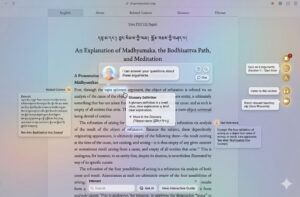
We plan to turn our reading room into an interactive study room and app, with AI-powered instructor chatbots to answer questions and in-built quizzes to test understanding. Texts will be seamlessly linked to excerpts from relevant teachings, and practice instructions partnered with the practices they relate to.
3D Sadhāna Initiative

We plan to create immersive online sadhāna experiences in which practice materials are enriched with clickable instructions, chopön and umze guidance, videos of mudrās, and visualization aids — evolving over time into a fully three-dimensional experience allowing practitioners to enter the maṇḍala.
Tech Press Releases & Updates
Translation Agent
To support our translators, the Khyentse Vision Project has developed our own AI Translation Agent. This agent utilizes custom tooling built out of our own data and workflows, helping our translators to produce and develop drafted translations as part of our Loshimi Translation Studio. Pushing beyond standard AI translation, our agent intelligently invokes our own database of translations, our glossary, and our style and review guidelines to ensure that difficult material is given the appropriate context to produce a quality translation. Through rigorous testing we have found that our agent provides 38% higher quality translations of this content than any commercially available AI.
Copy Editor Agent
Producing high quality translations is about more than just moving from one language to another. To assist our editors in catching any errors in grammar, punctuation, or other copy-editing issues, we have developed our own AI Copy Editor Agent. In addition to the standard copy-editor’s toolkit, our agent implements our internal style and voice guidelines in a workflow directly modeled after our human review process. Our agent successfully catches 100% of grammatical and mechanical errors in our testing suite, and even catches a number of errors that human editors miss — allowing them to focus on the subtle nuances of the dharma in the way that only human specialists can.
Multi-Agent System
In the Loshimi Translation Studio, our AI Translation and Copy Editor Agents work together in what the tech world calls a “Human-in-the-Loop Multi-Agent System.” This helps us orchestrate our work so that AI handles what it does best, while humans focus on what only they can do. Outside of our primary translation workflows, this system can also run autonomously — not to produce translations for publication, but to simulate our human workflows and study how the pieces of our process impact one another. This allows us to quickly test and validate our workflows without placing undue burden on our staff.